⚙️ Process: the invisible scaffolding that makes or breaks a brand
One of the most impactful, overlooked parts of marketing...plus rawjobbing, the monks walk for peace, and Fernando's LinkedIn

Did everyone stay warm this weekend?! We had a lovely snow day on Sunday sledding, drinking hot chocolate, and making paper snowflakes. And now we are on snow day number 3 and I’m running out of ideas and my son’s school is closed again and this newsletter is a day late bc of it and I’m writing this at 4 am after feeding my baby. If there are any typos that’s why. 😅 On a more serious note, this weekend was also very heavy because of everything happening in the news right now and I do not want to ignore that. I have included some verses below that have been a source of encouragement for me, and hopefully for you too.
🐝 Pollen [week of Jan 26]
Inspo to get your brain buzzin and make your brands break through.
Rawjobbing - a facetious new word for just doing your job. 😂
4 key takeaways from Davos along with the global risk report (methodology here) ranked by severity in the short term and the long term. These risks are important to consider as a strategist to understand what fundamental shifts are taking place that impact your audience on a macro level, and what headwinds your brand should be taking into account. Also interesting to see how it’s shifted from 2025.
360Brew is LinkedIn’s new algorithm and Richard Van Der Bloom shared his perspective on what this means for your content approach. This is one of the biggest shifts in the algo in a long time and worth the read. The TL;DR is that the algo isn’t reading each post by the keywords, it’s now creating a holistic picture of your content and serving it up to relevant audiences based on that.
Speaking of LinkedIn, my new fav follow is Heisman and National Championship CFB winner, Fernando Mendoza. He is crushing his LinkedIn game right now and is “open to work” for the NFL Draft lol
The monks continued walking for peace through Raleigh this weekend despite the extremely cold temps and snow. Their walk is a beautiful response to a very harsh state of the world right now.
The world is very heavy right now. As I was reading my Bible this morning, these verses brought me comfort and I hope they do you too: Psalm 11: 4-7 and Isaiah 40:22-24. God is on his throne and he sees everything - nothing gets past him. He is incomparable in his strength and might, and he is in charge of the rulers of this earth. He is just and he will repay the wicked with what they deserve.
A running list of all the Super Bowl ads for the upcoming game.
A fun social format to try this week, “editing our launch video like a [fill in the blank] tv show”. Here’s a fun execution Graza did for the release of their new mayo in the style of a reality tv show
My favorite “My impressions of an Owl as ___” is an owl as Ms. Rachel
Abercrombie, the official fashion partner of the Super Bowl, is throwing a fashion show event the day before the big game. Kyle Smith, the NFL’s fashion editor, shared, “If you look at Abercrombie & Fitch’s history, it’s 134 years old. When I went to the brand’s headquarters to broker this deal, I saw a pair of trousers that had been worn by JFK there — I got goosebumps. So the show is inspired by their long, rich history, and then adding an NFL lens to it.” We talked about the fashion’s influence on sports a while back, and I think this is a very smart move for Abercrombie.
How the South responds to cold weather. I can verify this is true 🤣
⚙️ Process: the invisible scaffolding that makes or breaks a brand
In my experience, one of the most important and often overlooked ingredients for creating work that breaks through culture is process.
As great as marketing plans are, we all know that culture throws curveballs, and if you want to connect with culture, you have to move at the speed of culture. Which means you have to have a process that enables that.
Something I keep noticing lately is that some of the biggest, most successful marketing moments for brands were UNPLANNED.
What I’ve learned is that process is the invisible scaffolding that helps idea seedlings take root, allows them to work through the system effortlessly, and enables teams to work fast so they don’t miss the moment.
Process can make or break a brand.
Sure, there are a LOT of factors involved. However, even if you have the most stacked team, but have a bad process, you’re not getting anywhere. I promise.
I’ve been a part of teams with amazing processes, and I’ve been a part of teams with the worst processes you can possibly imagine (like presenting a marketing plan to twelve executives individually, changing the deck each time based on their feedback, to get to the final presentation with the CEO who shares that the entire goal has shifted that no one else knew about…).
I’ve also often been in charge of figuring out what the right process is for the teams I’ve led. Process is essentially strategy applied through a different lens: how to activate teams in ways that will be most effective.
Unfortunately, changing process can be one of the hardest changes to make inside a company. It becomes a lightning rod because process is a reflection of the company culture and it directly impacts people’s job responsibilities, power, and ultimately, their egos.
Do you want more, better ideas, in faster time, that are more successful? Then you might want to rethink your process.
Let me give you some recent examples of great outcomes due to great process:
Topgolf: Rachel Karten interviewed Topgolf’s social media manager, Nili Kamolidinova, about the 4 Logan campaign and this quote stood out to me: “For other brands looking to capitalize in a similar way, I recommend having the systems in place that allow you to move quickly. This campaign worked because we could make decisions fast and execute immediately.”
Bobbie: In my interview with Kim Chappell, Bobbie’s Chief Brand Officer, she shared, “All three of those examples (Molly Baz, Cardi B, SNAP program cuts) were not part of our marketing calendar. They were opportunities that came to us or topical moments where we had to decide whether to act. The best thing you can do is be nimble — be ready to throw the plan in the trash, pivot quickly, take risks, and be bold.”
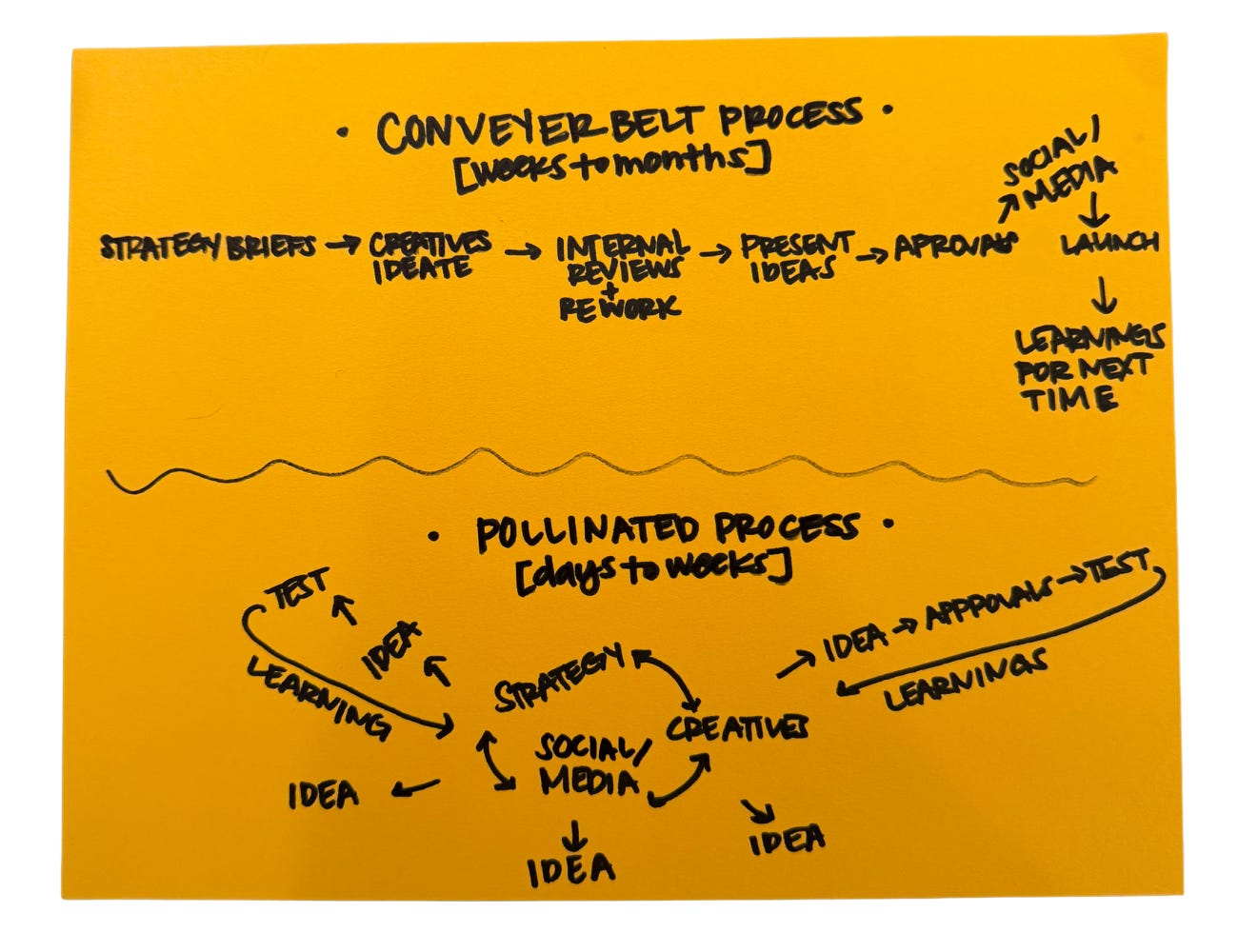
SharkNinja: In my interview with Stacy Carpenter, VP of Social at SharkNinja, she told me that they prioritize an “agile operating rhythm” where they “move in rapid cycles: test → read signals → iterate → redeploy. It’s a constant loop rather than a linear process. The whole org is wired this way, which lets us create and adapt at speed.”
Duolingo: When I worked at Duolingo, one of the biggest differences I recognized right away was their process. No big marketing strategy and plan, just constant experimentation, iteration, and “doubling down on what works”. Manu, the CMO, shares a little bit about it here. I highly recommend reading the Duolingo handbook, which I helped launch, specifically about their process they call “the green machine”. A proof point of this is when I saw the biggest earned media campaign unfold in real time on Slack: the death of Duo, which drove 1.7B impressions. Zaria Parvez broke down how the campaign unfolded here. Notably, “it was a campaign that came to life in 6 days and had a total flight for 21 days.”
Netflix: Years ago I worked at Mediahub on the Netflix account in the heyday of their original content. I helped launch Stranger Things Season 1, The Crown S1, Narcos S2, Black Mirror S3, all of their Marvel shows and many many many more. There were five of us on the team to start, and we built the rest of the team from the ground up. One of the biggest reason for success (if not the biggest), was our way of working. We had a SWAT team of multi-disciplinary specialists brainstorming, ideating, debating, arguing, honing, AND executing ideas all together.
Now let’s dive deeper. Below the paywall I break down the following:
A better type of process aka the “pollinated process” as seen in my beautiful hand-drawn chart below (inspired by Rachel Karten’s written sticky notes!)
Key ingredients for a successful process (it’s not what you think)
Five ways you should consider shifting your marketing planning based on the ideal process
How to successfully change processes inside a company